6/29/2007

Spirogyra - Silk Algae, Water Silk


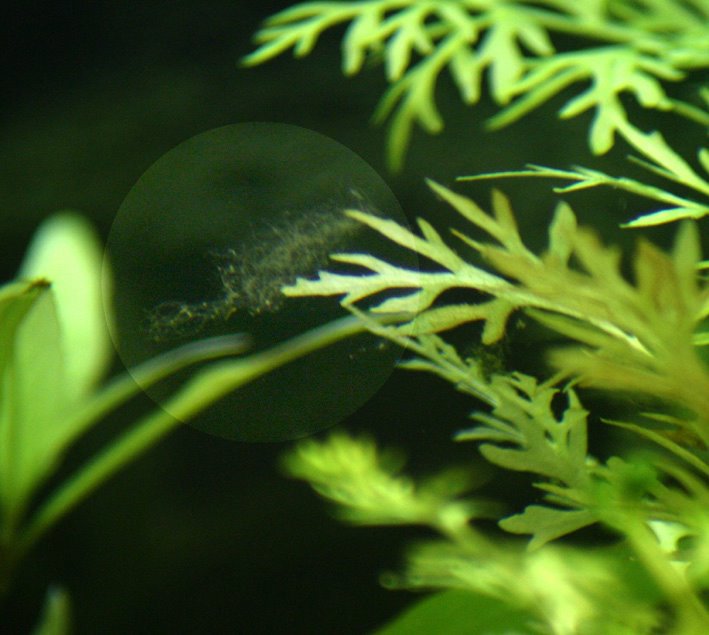
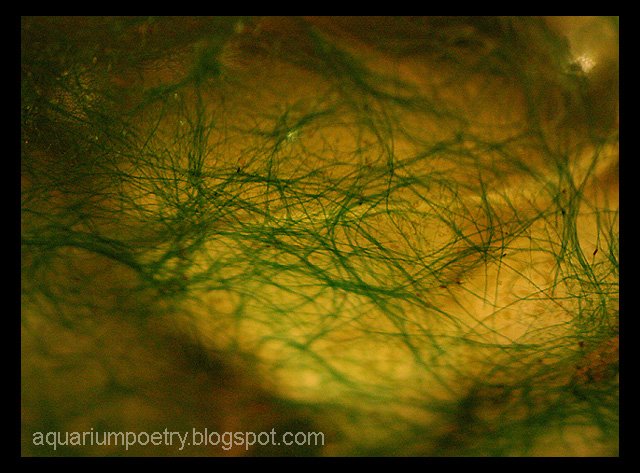
This non-branching green filamentous algae is called Spirogyra. This algae doesn't appear in polluted water systems but in ones that are eutrophic, rich in nutrients (liquid ferts, CO2 and light).
It grows very fast, forming long, entangled strands. I would personally call this one the "spaghetti algae" :-) , the way it looks to me. I am not sure algae eaters will eat Spirogyra. This aquarium of mine has Otocinclus and Neritina Zebra snail, and they are not showing any interest in eating it.
I have removed this algae manually, very easy really.

Since the beginning of this set-up I have used the Estimative Index fertilising regime, dosing 2-3 times a week N,P,K, traces and liquid Carbon (Easy Carbo), so I don't think any nutrients were missing.
There is one problem I have caused (I assume). Instead of performing 50% weekly water change I did 25% every 2nd or 3rd week. I wouldn't say that irregular water change induced this algae but dirty filter (I clean filters with each water change). The filter gets dirty and reduces the water circulation. Less circulation = slower nutrient transport. Also weaker surface agitation = less Oxygen.
I did some tests by doing water change every 3-4 weeks but cleaned the filter every week to keep good flow and moderate surface agitation and this algae never came back.
So keep your filters clean ;-)

Photos by Dusko Bojic.

6/02/2007

Surface Scum/Film (edited May6th 2010)


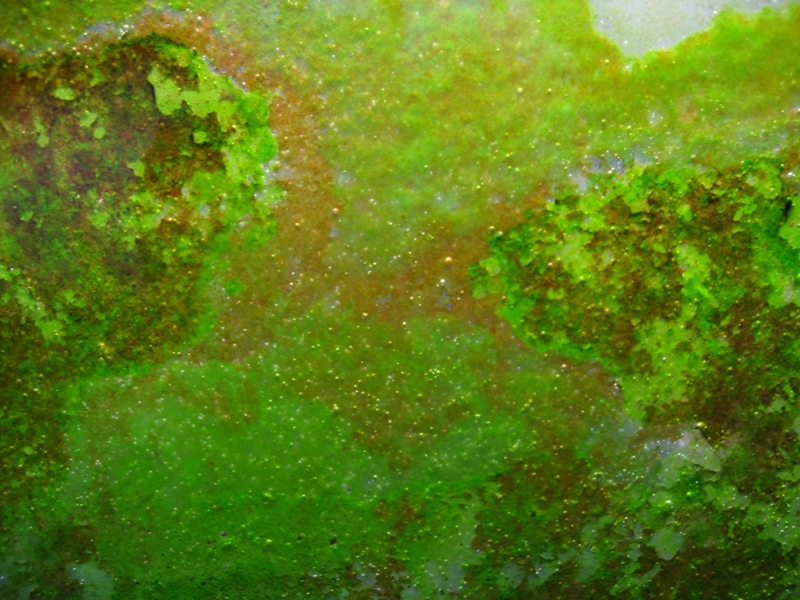
This is a protein bio-film, probably triggered by hi organic levels, poor circulation and low CO2 levels.
Neuston organisms readily develop in it (or underneath it), like bacteria/zoo-spores/protozoans, hydras, worms even small snails.
This scum is very compact and often green. It is impossible to break it with the finger. I have tried it, and the film just grows back together in a second. Visually it appears "oily".
I have removed the film by using paper kitchen towels, laying them over the surface many times, until the scum was gone. After that I have performed a huge 80% water change, rinsed the filter media very well (that in fact was dirty) and have introduced one extra filter pump (extra circulation and surface agitation).
Also, I started using Easy Carbo (like Excel) instead of the CO2.
Everything seems to be in order now.
One more thing, I didn't prune plants in a long time so they covered the entire surface. And because of that, the tank circulation was poor, causing probably lower O2 levels as well. All this induced the surface scum.

There is another type of surface film caused by the Eisenbacteria (Iron bacteria). This film appears to be whitish, much thinner and breaks easily on touch. Improving surface agitation will help in combating this kind of film.


Observation;
I have fixed this surface film (white and green) in 3 different tanks by simply introducing an air pump or aplying the venturi air diffuser to the power head (without removing it the film would disapear by the next day). The air bubbles seem to be breaking the surface tension causing the surface film to break into tiny particles which sink to the bottom or get trapped in the filter (in both ways bacteria will break them down).


Photos by Dusko Bojic.

Cladophora algae


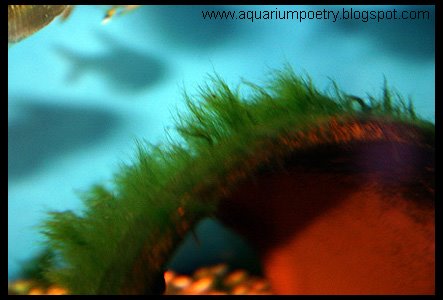
Cladophora is a branching, green filamentous alga, that forms a moss like structure. This algae doesn't appear to be slimy. Threads are very strong and very thin. It grows on rocks and submersed wood exposed to direct light, in very bad cases will grow on plants also. Usually it tend to stay on one spot, which makes it easy to remove. Comb it and dose more CO2 and improve water circulation for better nutrient transport. In a case where Cladophora takes over the grassy plants, mow the plants like the lawn. No algae eater is known to eat this kind of algae.Photos by Dusko Bojic.

6/18/2006

Black-Beard Algae (BBA), Red-Brush Algae

Unstable CO2 levels will induce BBA!
The best way to combat Brush algae is by maintaining CO2 at 30ppm, nitrates at 15ppm and phosphates at 0.5ppm. Leaves that are badly overtaken should be discarded. Observations;When I had a problem with BBA, I dosed 1ml per 50 liters of Easy Carbo (equivalent to Flourish Excel) every other day for a week. The algae turned purplish/pinkish and disappeared. Maintaining sufficient CO2 level and is the best way in controlling this algae. Siamese Algae Eater will eat BBA.
Photo by Dusko Bojic.

Green Dust Algae (GDA)

Green Dust Algae are actually zoo-spores and are commonly found on aquarium glass. They form a dusty looking, green patchy film and in severe cases can cover the whole aquarium glass. It's not known what actually causes this algae. Intense light is favored by GDA. Scraping it off the glass will not help remove this algae since it stays in the water and will float for 30-90 minutes before attaching it self again to the glass. For some reason those zoo-spores are avoiding plants, rocks and wood and always go for the glass. Limiting nutrients will not help fighting this algae but rather cause problems in planted tanks where plants will be exposed to nutrient deficiency and that condition will just favour other algae types. The best known solution, for how to get rid of GDA, has been discovered by Mr. Tom Barr. He claims that this algae should be left alone to grow, without wiping the glass for about 10-20 days. After this period GDA will start forming ticky patchy film that will start falling off the glass. When this starts happening it is good to remove this algae out of the tank. This method should keep this algae at bay.

And since one photo is worth 1000 words :-) ...
Joe Aliperti (photo credit) gives us a visual insight into this interesting (or better, annoying) algae.
The first shot shows the algae over-taking the front glass;

Second photo - the close up.
The last photo was taken exactly 3 weeks after the GDA took over the front glass, just after the total clean up :-). A sparkling aquarium. Thank you for sharing these beautifully taken photos Joe Aliperti.
Photo credit Joe Aliperti. Do not copy without a written permission, please. Thank you.

3/04/2006

Green water - Algae bloom

Green water (algae bloom) Beautifully made photo by Ron© .
This is the most common problem if the cloudy situation extends beyond 10-14 days. Note that "green water" is not always green in appearance! Since green water is the most common problem and the most difficult to solve the answer needs to reflect several options. The situation that causes GW (Green Water) is usually a combination of high nitrates, phosphates, and mixed in some ammonia/ammonium. Substrate disturbance is usually the culprit. What happens is the algae (GW form) will flourish off of the ammonia/ammonium and phosphate, remembering that algae can consume phosphate easier than plants because of their thin cell walls, the algae uses up the ammonia/ammonium and phosphate, but it doesn't go away...because algae can quickly switch with nutrient it scavenges...it moves to nitrates. So you can see why water changes will not rid a tank of GW. Nutrients can be reduced very low in GW and fairly quickly by the GW algaes, but they can scavenge other nutrients...iron and trace elements. So, it's very common for the GW to solve the situation that causes it to begin with, but that won't eliminate the GW, for the reasons I've allude to. Five methods exist to eliminate GW. Blackout, Diatom Filtering, UV Sterilization, Live Daphnia, and Chemical algaecides/flocculents. The first four cause no harm to fish, the fifth one does.
Method No. 1 The blackout means covering the tank for 4 days, no light whatsoever is allowed into the tank during this time. Cover the tank completely with blankets or black plastic trash bags. Be prepared, killing the algae will result in dead decaying algae that will decompose and pollute the water. Water changes are needed at the beginning and end of the blackout time and ammonia should be monitored also.
Method No. 2 Diatom filters can usually be rented from your LFS. This is my preferred method. Personally, I use my Magnum 350 w/Micron Cartridge coated with diatom powder. Diatom filtering removes the algae and doesn't allow it to decay in the tank. You do have to check the filter often, if you have a really bad case of GW the filter can clog pretty quick. Just clean it and start it up again. Crystal clear water usually takes from a few minutes to a couple of hours.
Method No. 3 UV Sterilizers will kill free floating algaes. They also kill free floating parasites and bacteria. They also can be problematic for extended use in a planted tank, as they will cause the “breakdown” of some important nutrients. They are expensive and don't remove the decaying material from the tank, if you can afford to keep one they are handy to have around, though not as useful IMO as a diatom filter.
Method No. 4 Adding live daphnia to your tank. This can be a bit tricky. First you need to insure that you are not adding other "pests" along with the daphnia. Second, unless you can separate the daphnia from the fish, the fish will likely consume the daphnia before the daphnia can consume all the green water.
Method No. 5 I hate the last way, the flocculents stick to the gills of fish, while not killing them it does compromise their gill function for quite a while leaving them open for other maladies.
Beautifully written article by Steve Hampton© ; more on Aquarium Plants.com

----------------------------------------------------
"Green Water - Dusko's Lazy Solution to the Problem"
Photo credit Dusko Bojic


I got a very bad algae bloom (Green Water) due to CO2 malfunctioning ( + 2 of my HOBs malfunctioning also). At first I wasn't sure what to do. I had very little free time and such Green Water case needed many water changes and adjustments.
I decided to try something new!!! Instead of the everyday water changes and fuss I decided to introduce LOTS of floating plants, almost covering all the water surface. I got Salvinia natans floating plant. I disconnected the CO2.
Since "green water algae" thrive in water with NH4 and strong lights, I planned to add floating plants to shade the tank (something like black-out) and to uptake the NH4 from the water column.
I also started dosing Easy Life FFM (fluid filter medium) in USA aka Easy Neo. This fluid product has a very good CEC (cation exchange capacity) and is able to bind NH4 very fast. I dosed Easy Life FFM every second day (recommended is once a month).

This next photo was taken approx 10 days after I had introduced the floating plants and Easy Life. Amazing!! And I didn't do any water change at all !!


Today this aquarium looks like this (following photos). I disconnected the CO2 and am running this tank as a Hi-light Low-tech covered with floating plants. The submersed plants seem not to mind these unusual conditions without CO2. I do dose Tropica+NPK 10ml every week. Instead of water change I only top up the evaporated water and re-dose with 10ml of Easy Life. Today I have no algae at all and plants which grow healthy.


Green Spot algae


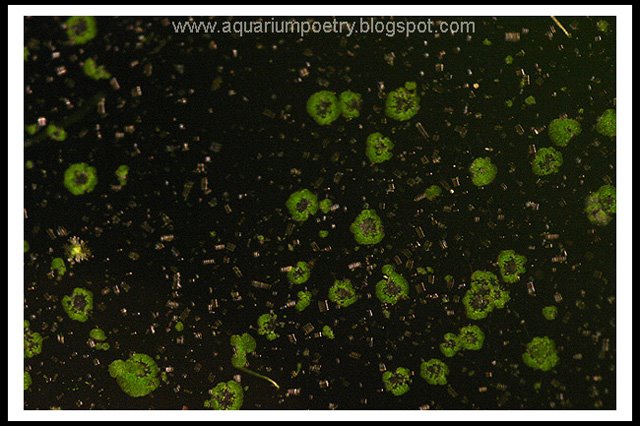
The 3rd photo is made with a macro lens. Those green dots are smaller than 1/2mm.
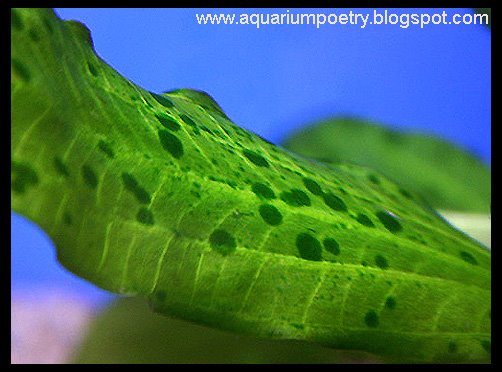
Green Spot Algae prefer direct light. It forms green spots on aquarium glass and slow growing plants that are exposed to strong light. This algae will appear if CO2 and Phosphate (PO4) levels are low. Since it is very hard, algae eaters can't do much in eliminating this algae. Neritina Zebra snail is the only algae eater known that can, literally, eradicate the Green Spot Algae. It can be scraped manually off of the glass with a razor blade. In a case of an acrylic aquarium use plastic razors only. This algae is considered normal in small amounts.
To prevent this algae keep stable CO2 levels, dose NPK regularly and improve the water circulation throughout the tank for better nutrient transport. Keep slow growing plants in places where they will get less light.

Dusko Bojic.

Staghorn algae (UPDATED)


Staghorn Algae grow in long individual, grey-green strands, that form a few branches. It will grow close to the light source on equipment and plants. One good thing about this algae is that it tend to stay at one "favorite spot" in the aquarium and doesn't propagate fast. Strands can be pulled off the surface or in very bad cases the whole leaf should be discarded. Higher ammonia/ammonium levels (overstocking and substrate disturbance) and low CO2 levels will favour this algae. Its been known that the Siamese Algae Eater will keep this algae in check. Nutrient control and plant pruning will limit Staghorn algae.
Observations 1;
My aquarium got suddenly infested with this threaded Staghorn algae. It is only growing on Microsorum leaves and on the filter out-let. Shrimps don't show any appetite towards this type of algae. After two days of observations I have found the culprit. Algae infected only the old Microsorum leaves. So, I pruned off the infested leaves, and the SA didn't return. The older leaves were leaking out nutrients back into the water column favoring this sort of algae.
Observation 2;
I experienced a huge infestation of Staghorn algae on Crypto and Anubias leaves in 2 aquariums of mine. I introduced a few Amano shrimps (Caridina multidentata) and I could see the algae disapearing after only a few days. I could observe the Amano shrimps sitting on the leaves and eating the Staghorn directly with their mouth (usualy shrimps pick the algae with their front legs). Highly recomanded shrimp :-)

Photos by Dusko Bojic.

Thread algae

Thread Algae grows on leaf edges as a single, up to 30cm long, thread. It is easily removed by twirling a tooth-brush around it. Excess iron is a possible reason. It is good to use ground iron fertilisers since this algae uptakes the iron from the water. Healthy plants will out-compete this algae. It is known that algae eaters like SAE and Caridina japonica will consume it, as well as Barbs. Thread algae is very likely to appear together with the Hair algae.
Observations;
My SAEs, American Flag-fish, Neritina Zebra snails, Red Cherry shrimps, Otos don't show any interest in eating this sort of algae.

Photo by Irons.

Green Beard Algae

Green Beard Algae can be a vary attractive addition to an aquarium with big pieces of stone and/or bog-wood. It forms a tick green carpet over the surface closer to the light source. It is very soft and slippery but it is impossible to be removed mechanically. It can also be seen on slow growing plant leaves. It grows approximately 3 cm and the growth is rapid. The best way to control this algae is with the Neritina sp Zebra snail that will eridicate it. Siamese Algae Eater, Plecostomus spp. are known to eat this algae as well as the Rosy barb and a very aggressive fish called the Red Tailed Shark. Keeping lights for more than 12 hours a day will trigger this algae as well as unbalanced nutrient. It will show up in planted tanks with low CO2 and NO3 levels. This algae can be found in low and high pH waters. Green Beard Algae is very common in non-planted aquariums.
Photo by Dusko Bojic.

Hair algae

Hair Algae forms around the base of slower growing plants, on gravel and bog-wood. It has green-gray color. It grows up to 4 cm sometimes more. It is easy to remove this algae by twirling a tooth-brush around it. Most aquarists find this algae very welcome as a good food supplement for their fish. Most omnivorous fish like Angels or Barbs will supplement their diet with hair algae if not over-fed. In stronger water currents this algae forms matted clumps, as well as that, stronger water current will disturb their growth. All algae eaters will be more than happy to look after the Hair algae for you.


Photos by Dusko Bojic

Brown algae


The 2nd photo is made with a macro lens. Brown algae diatoms have rectangular shape. This photo represents one small brown patch form the 1st photo.
Brown Algae (diatoms) are more likely to appear in low-light aquarium and new set-ups, with excess silicate acids (SiO2). Its been known that strong lights make this algae go away, but they might still be seen on lower, shadowed, plant leaves. It can also be found on aquarium glass, gravel and decoration. It can be easily removed manually, since it has a soft/slimy structure. Otos (this catfish relishes this type of algae) and Snails can easily keep this algae in low numbers.

Photos by Dusko Bojic.

Fuzz algae

Fuzz Algae grow on leaves and plant stems not necessarily exposed to strong lights. The effected plants are probably suffering deficiency problems and are leaking nutrients back into the water. This algae is considered normal in small extend. Aquariums with fish such as Siamese Algae Eater, Otos, Amano shrimps, Bristlenose pleco or Molly will not suffer from this algae. Balanced plant nutrients will give a head start against the algae.

Photos from www.mikes-machine.mine.nu/

Blue-green, Slime or Smear algae

Blue-Green Algae even though called algae, is not classified anymore as one. This "algae" is actually cyanobacteria. It forms slime, blue-green, sheets that will cover everything in a short time. It can be removed mechanically but will return quickly if the water quality is not fixed. It can be treated with Erythromycin phosphate, but this might effect the nitrifying bacteria in the gravel and filter. When the BGA gets killed by the algaecide it will start to rot and through that process it will reduce Oxygen levels in the tank. Since the nitrifying bacteria needs O2 to transfer ammonia/nitrItes into nitrAtes the nitrifying process will slow down. If algaecide is used, make sure to test the ammonia/nitrite levels. Remove all the visible algae to prevent it from rotting in side the tank. Some aquarists use the black-out method, where black bags are wrapped around the tank for 4 days and held in complete darkness. It is advisable to raise NO3 levels to 10-20ppm before starting the black-out period. All visible algae should be vacuumed before black-out and after the black out.Egeria densa (Elodea) and Ceratophyllum demersum are good plants to have in a tank. These plants secretes antibiotic substances which can help prevent Blue-Green Algae. Establishing, lots of healthy, fast-growing plants from the day you start the tank + dosing the nitrAte levels to maintain 10-20ppm (in planted aquariums) and vacuuming the gravel (in non-planted ones), is the best way to prevent this "algae". The BGA can be found in aquariums with very low nitrates because it can fix atmospheric nitrogen. BGA seem not to like very low pH and high CO2 levels. BGA doesn't prefer strong water currents. Excess organic loading is the real cause in many cases. Try removing decaying plant material and prune old leaves that are leaking organic nutrients back into the water column.

Photos by Dusko Bojic